
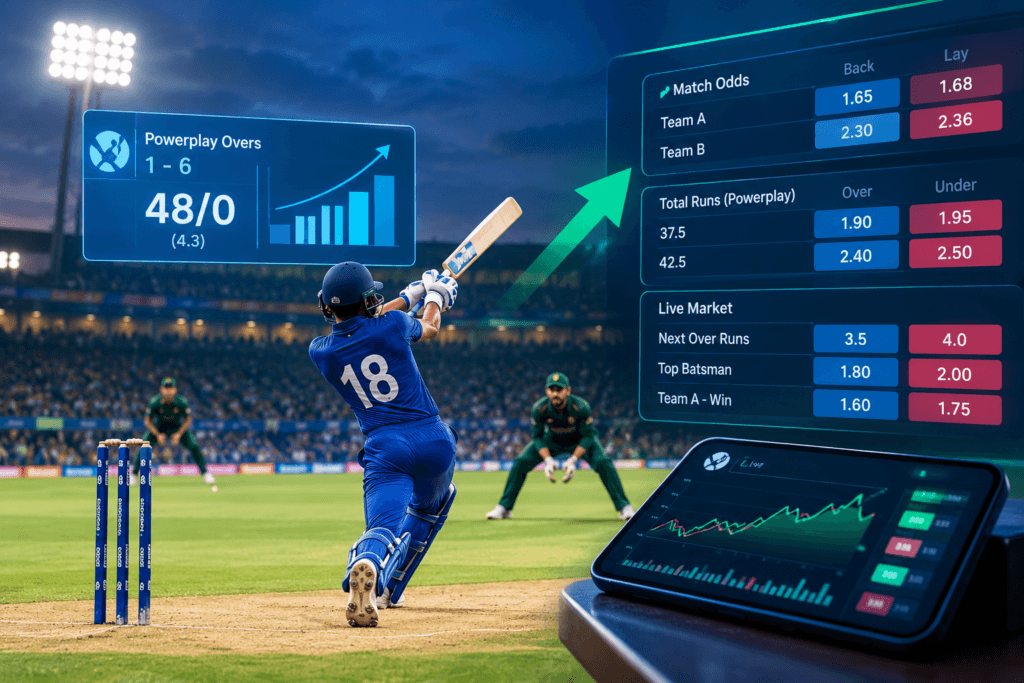
A strong or weak opening six overs can change the way a T20 match is viewed in real time because early runs, wickets and scoring rate provide the first clear indication of how comfortably a batting side is using its powerplay. On allpanel9 global, understanding that context means looking beyond the score alone and considering how the current run rate compares with the match situation, pitch conditions and wickets available.
Why the Powerplay Matters in T20 Cricket
The powerplay is not simply the first part of a T20 innings. It creates a different tactical environment because fielding restrictions give the batting side more opportunities to find boundaries in the early overs.
Under current ICC Men’s T20I playing conditions, the first six overs are designated as Powerplay overs. During this period, only two fielders can be outside the fielding restriction area at the instant of delivery. When an innings is shortened, the number of Powerplay overs can also be reduced according to the applicable playing conditions.
That restriction influences how captains use their bowlers and how openers approach the innings. Batters may attack the field during the early overs, while bowlers often look for wickets before the field spreads.
For live cricket markets, this creates an important distinction: a score is more meaningful when it is considered alongside the number of wickets lost and the overs remaining.
Runs Alone Do Not Tell the Full Story
Suppose a team reaches 55 after six overs without losing a wicket. Another team might also reach 55 after six overs but lose three wickets along the way.
The scores are identical, but the match situations are very different.
The first side has preserved its opening batters and can potentially increase the scoring rate through the middle overs. The second side has fewer established batters at the crease and may need to rebuild before attacking again.
This is why live market interpretation cannot depend on one number.
Several factors should be considered together:
- Total runs after the powerplay
- Wickets lost
- Current scoring rate
- Batters at the crease
- Quality of bowlers still available
- Pitch and weather conditions
- Required run rate when chasing
A 60-run powerplay can look excellent in one match and ordinary in another. If the pitch is particularly good for batting, expectations may already be high. If conditions are difficult, the same score may represent a much stronger start.
Scoring Rate Gives the Score More Context
Run rate is one of the simplest ways to add context to a powerplay score.
For example, 48 runs from six overs represents a scoring rate of 8.00 runs per over. A score of 66 from six overs represents 11.00 runs per over.
But even that comparison needs caution.
A team scoring at 11 runs per over may have taken significant risks. If two wickets have fallen, the apparent advantage could be less meaningful than the scoreboard suggests. Conversely, a side scoring at eight runs per over without losing a wicket may have created a stable platform for the next phase.
Live markets therefore tend to respond to the developing match state rather than simply rewarding the highest number on the scoreboard.
The same principle applies when comparing teams in a chase. A side at 52 after six overs could be in a comfortable position if the target is modest, but under pressure if the required rate later becomes difficult to maintain.
Wickets Can Change the Meaning of Powerplay Runs
Wickets are particularly important because they alter the resources available to the batting side.
A team finishing the powerplay with plenty of runs but several wickets down has less batting depth available than a side with a similar score and all or most of its wickets intact.
This becomes even more important when the next phase of the innings is expected to require acceleration.
For example, imagine two teams both score 58 in their opening six overs.
Team A loses no wickets.
Team B loses two wickets.
The market context can differ because Team A has greater flexibility to attack later, while Team B may need to manage risk and rebuild around its remaining recognised batters.
That does not mean the second team is automatically in a poor position. Cricket conditions, player quality, target size and venue characteristics can all change the interpretation.
How allpanel9 global Can Help Frame Powerplay Market Context
The useful approach is to treat allpanel9 global as a reference point for understanding the information surrounding a live cricket market rather than looking at one isolated price or score.
A powerplay market can change as new information arrives. A boundary-heavy over, an early wicket, a dropped catch or a sudden slowdown can all alter expectations about the next phase.
This is where timing matters.
A team that starts aggressively may cause expectations to shift quickly. But if the scoring rate falls immediately after the fielding restrictions end, some of that early momentum may disappear.
Likewise, an early wicket does not always produce a long-term change. If an established batter remains at the crease and the incoming player settles quickly, the situation can stabilise.
The important question is therefore not simply, “How many runs were scored?”
It is:
“What does the powerplay result tell us about the innings from this point onward?”
Fielding Restrictions Shape Early Scoring Opportunities
The tactical reason behind powerplay scoring is closely connected to field placement.
With fewer fielders allowed outside the restriction area, captains have fewer defensive options against aggressive batting. Openers can target gaps and boundaries that may become harder to access once more fielders move to deeper positions.
After the powerplay, teams can spread the field more effectively. This changes the balance between singles, boundaries and wicket-taking opportunities.
That transition matters when assessing a live match.
A team that scores quickly during the powerplay may not maintain the same rate once the fielding restrictions disappear. Equally, a side that starts slowly may have deliberately prioritised wicket preservation before accelerating later.
So the end of the sixth over should be viewed as a change in match conditions, not simply the end of a statistical segment.
Reading the Transition After Six Overs
One of the most useful moments in a T20 innings comes immediately after the powerplay.
Consider a side that reaches 62 without losing a wicket. The next question is whether it can continue scoring efficiently against a more defensive field.
If the scoring rate falls sharply, the earlier powerplay advantage may become less significant.
On the other hand, if the team continues finding boundaries while rotating strike effectively, its early start may develop into a much stronger innings position.
The same applies to wickets.
A side that loses an opener in the sixth over may enter the middle overs with a different strategy from one that completes the powerplay with both openers settled.
This is why live analysis should follow the match as a sequence rather than treating every over as an isolated event.
Powerplay Momentum and allpanel9 global
Powerplay momentum should be understood as a developing situation rather than a permanent advantage.
A fast start can influence expectations, but the market context can change again after a wicket, quiet spell, bowling change or shift in required run rate.
This makes it useful to compare the current situation with what was expected before the innings began.
For example, 50 runs after six overs may represent an above-par start in one match and a below-expectation start in another. Pre-match expectations, pitch behaviour and team composition all provide additional context.
The Difference Between a Fast Start and a Strong Position
A common mistake is to treat aggressive scoring as automatically meaning that a team has control of the match.
That is not always the case.
A team can score 70 in the powerplay but lose three wickets. Another can score 52 while preserving its entire top order.
Which situation is more valuable depends on what follows.
If the pitch is becoming easier to bat on, preserving wickets may become extremely useful. If the surface is difficult and wickets are likely to fall later, early acceleration may carry more significance.
The match situation should therefore be assessed through several connected signals rather than a single powerplay statistic.
This principle also applies when comparing information across different cricket platforms. A market displayed through a service such as tigerexch should still be interpreted through the actual match conditions rather than assuming that a particular price or movement tells the entire story.
What to Watch During the Powerplay
A practical way to follow the opening six overs is to track the relationship between runs and wickets.
Start with the score, then ask:
- How quickly are runs being scored?
- How many wickets have fallen?
- Which batters are currently established?
- Are boundaries coming from controlled shots or high-risk attacking play?
- Which key bowlers have already completed an over?
- What could change once the fielding restrictions end?
This approach produces a more useful picture than simply checking the scoreboard after every over.
It also helps explain why two matches with similar powerplay scores can develop in completely different directions.
Why Powerplay Analysis Still Matters After the Sixth Over
The influence of the powerplay does not disappear when the restrictions end.
Its effects can continue through the middle overs because the opening phase determines the platform available to the batting side.
A strong start with wickets preserved can allow greater freedom later. A slow start may force the middle order to increase the scoring rate. Early wickets can bring less experienced batters into the game sooner than expected.
In a chase, the consequences can be even clearer because the opening overs affect the remaining required rate.
For that reason, powerplay analysis is best viewed as the beginning of a match narrative rather than a final judgement on the innings.
Final Takeaway
Powerplay runs matter because they provide an early snapshot of scoring momentum, but the number itself is only part of the picture. Wickets, scoring rate, batting resources, fielding restrictions and the conditions of the match all determine what that start actually means.
The most useful live-market analysis connects those factors instead of reacting to a single boundary or scoreboard update. A strong powerplay can create a valuable platform, but the middle overs, wickets and changing match conditions ultimately determine whether that early advantage lasts.
FAQs
How many overs are in a T20 powerplay?
In a standard 20-over T20I innings, the Powerplay covers the first six overs. Current ICC playing conditions also provide for a reduced number of Powerplay overs when an innings is shortened.
Why can powerplay runs affect live cricket markets?
Powerplay scoring provides fresh information about a team’s scoring rate, wickets, batting conditions and ability to build an innings. That information can change how the remaining match is assessed.
Is a high powerplay score always a strong position?
No. A high score can be weakened by multiple wickets, difficult conditions or an unsustainable scoring rate. The number of wickets and remaining batting resources are important parts of the context.
What happens to scoring after the powerplay?
Once the fielding restrictions end, teams can place more fielders outside the restriction area. This can make some boundary options more difficult and often changes the tactical balance between batting and bowling.
Should powerplay runs be considered separately from the rest of the innings?
They are better understood as one phase of the innings. The score after six overs provides useful information, but later wickets, scoring rates, pitch conditions and the required run rate can change the overall match situation considerably.